
New educating skills
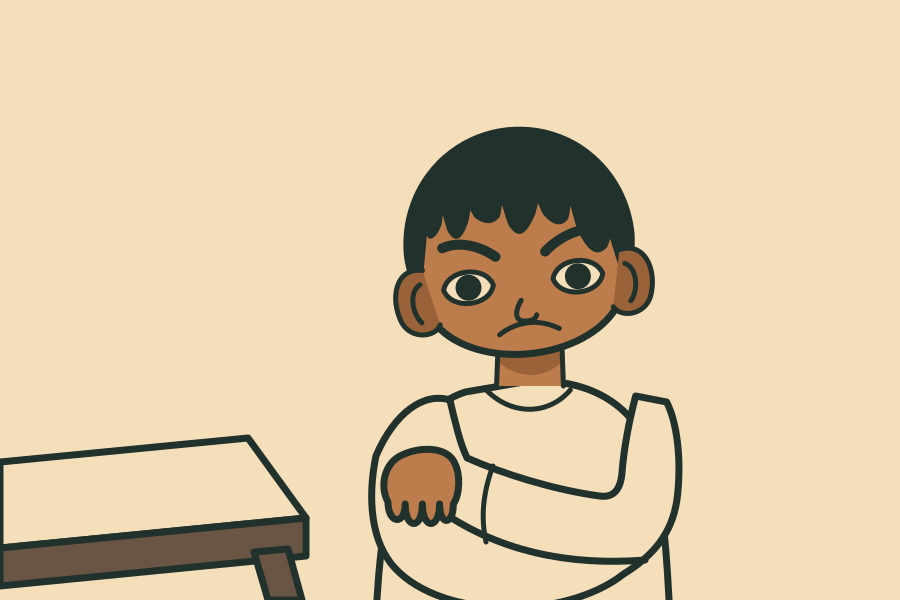
Let’s start with a student who
throws assignments on the floor every day.
Doesn’t participate in class. Doesn’t even try.
Marva Collins had just such a student.
His name: Gary.
— Marva Collins and Civia Tamarkin, Marva Collins’ Way, p. 82
Your challenge:
Educate such a student to
- willingly engage
- fail cheerfully and
- persist curiously.
It took five days for Gary to start making good choices.
1
Step one
Acknowledge Gary’s right to make his own choices.
2
Step two
Acknowledge what you can’t do — because it can’t be done.
You can’t force a student to make good choices.
You can’t force a student to learn.
3
Step three
Set boundaries, to protect the rights of other students to learn.
4
Step four
Act — not react.
Every day Ms Collins gave Gary homework — which he promptly threw or put under his desk.
Ms Collins did not reprimand him.
Instead, every day Ms Collins told Gary, in one way or another, and with a very good feeling, that she is on his side. That she wants him to succeed.
5
Step five
Present — even provoke with — consequences.
That’s it!
It took five days for Gary to begin to try — and fail.
But within months Gary was:
- engaging willingly
- failing cheerfully and
- persisting curiously.
Gary, like others, was positively helping to acclimatize newcomers with encouragement for future success.
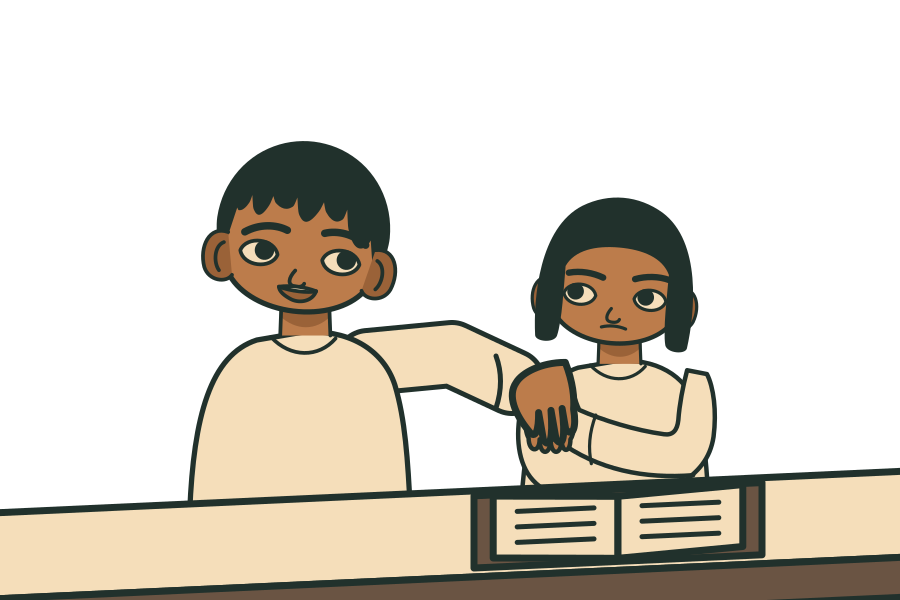
Let’s look at the steps in detail.
Excerpts below are from Marva Collins and Civia Tamarkin, Marva Collins’ Way, with the page given at each one. Emphasis inside the quotations is ours, not the book’s.
1
Step one
Acknowledge Gary’s right to make his own choices.
p. 82
Marva was introducing Tracy to Cindy when Gary Love, big for his age, bounded into the room, swaggering and snapping his fingers behind his back, jiving to some imagined music.
“Sweetheart, is your hip broken? If it isn’t, there’s no reason to come in here walking that way, slopping and popping your fingers. Why don’t you come sit over here?” Marva patted the back of one of the front seats.
Gary plopped into a desk in the middle of the room. “You make me.”
Marva shrugged. “I don’t make children do anything. You make yourself what you are. You must decide for yourself what you want to do in here, peach. You have the right to learn. You also have the right to fail, if you choose.”
2
Step two
Acknowledge what you can’t do — because it can’t be done.
You can’t force a student to make good choices.
Otherwise it wouldn’t be the student’s choice, would it?
Eva Fugitt on students making their own choices:
It was difficult and even painful for me to learn that I could not be “responsible” for the behavior of my students. Each student ultimately makes his own choice of response, even within a limited environment.
You can’t force a student to learn.
What happens between the ears — we have no control over that.
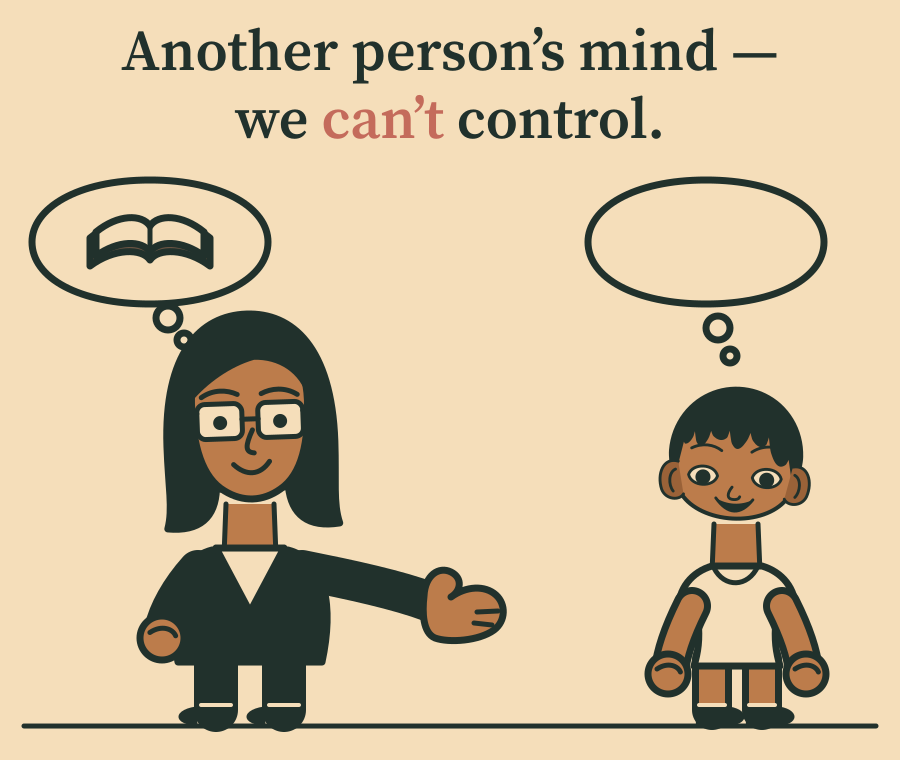
And if you’ve read the science, you already know that rewards and punishments don’t work for creative problem solving.
Eva Fugitt on the impossibility of forcing students to learn:
There was no way I could “make” a child learn to multiply, learn to read, learn to “be good” unless the child’s awareness at the time permitted her to choose to do these things.
— Eva D. Fugitt, He Hit Me Back First!, “The Search for a Better Way”
3
Step three
Set boundaries, to protect the rights of other students to learn.
p. 83
Gary had shunted himself off to the far left corner. From the look of the zig-zagged rows of desks, it seemed he had tried out every chair in the room before settling there. Gary’s eyes were closed as his head swayed and his fingers snapped, keeping beat to a tune playing silently inside him.
“Darling, no one is going to be handing out the good jobs to someone who sits there popping his fingers,” Marva said, ruffling Gary’s hair. He recoiled, turning his body to the wall. “You have a right to sit there all day staring at the wall if you want. You’ll never become a millionaire that way, but you can stare away if it pleases you. However, you cannot sit here snapping and tapping because you are interfering with everyone else’s right to learn.”
4
Step four
Act — not react.
pp. 84–85
The class repeats a line of affirmation together — everyone except Gary. This day has been given to me, fresh and clean. I can either use it or throw it away…
“Sweetheart, what are you going to do? Use your life or throw it away?”
Gary sat stonefaced, his arms across his chest.
“Of course it’s your life to do with as you please,” Marva reminded, “but there is a whole world out there calling you. If you throw away your life, you’re just letting society have its way.”
She spun around to face the other children.
“You know, boys and girls, there are some people who look at places like this, neighborhoods like Garfield Park, and they say ‘Oh, children from there are not very smart. They aren’t going to grow up to be anything special.’ If you decide to waste your lives, you are letting all those people be right. No one can tell you what you will be. Only you have the power to decide that for yourselves.”
Later the same day, when the students take turns reading words aloud, Gary refuses — busy twisting a pencil between his fingers, as though winding the propeller of a model airplane. Marva doesn’t force him. She says: If you pay attention and learn, you will have choices in life.
p. 92
I handed him papers and he tossed them on the floor. I called on him to read and he sat there silently. I said, “That’s your right, Gary.”
It was the same the next day.
But the day after, when I called on him to read, Gary decided to give it a try. He made it through the first few words. As soon as he had trouble, he flung the book across the room.
“You have to take stumbles before you can learn to walk,” I told him. “It’s all right to make mistakes. I make mistakes. I’m only a poor mortal and I don’t have all the answers. I don’t always understand things. I’m counting on you to help me with my mistakes and I’ll help you with yours.”
“However, I do not have all the money in the world to spend on books, and you have no right to destroy the ones we have. If you do not wish to use them, then someone else will, but you have no right to ruin them for others.”
5
Step five
Present — even provoke with — consequences.
pp. 87–88
Marva decided it was time to invite Gary into the lesson. She walked over to him, placed a hand on each shoulder, and whispered, “I’m not going to leave you alone. I care about you. Let’s try to do some work.”
“I’m not gonna do any damn work!” he shot back.
“You are too important to be left all alone. You are the most important child in this world, and people have left you alone for too long already. The Lord gave you a head to use, and if you care about yourself at all, and I know you do, then you will use it. I am not going to give up on you. I am not going to let you give up on yourself. If you sit there leaning against this wall all day, you are going to end up leaning on something or someone all your life. And all that brilliance bottled up inside you will go to waste.”
Marva took his arm and led him to the blackboard. He stood there, still determined to do nothing.
She considered it a victory. He had not run back to his seat or, worse, out the door.
“All right, children,” she began, “let’s first make a capital letter M, mmm. Why a capital? Because we are beginning a sentence. Vowel sound e, then vowel e again, then consonant t.”
When she finished, Marva glanced back at Gary, who was still standing in place with his hands in his pockets. Though she preferred to win her students with affection, she was no pushover. She felt that children needed and wanted discipline.
Towering beside Gary, she spoke matter-of-factly, carefully measuring her voice so he would not mistake her firmness for hostility.
“There is no one on this earth who is going to make me a poor teacher,” she said. “If you do not want to participate, go to the telephone and tell your mother, ‘Mother, in this school we have to learn and Mrs. Collins says I cannot fool around, so will you please pick me up.’”
Gary considered her statement for a moment, broke off some chalk, and scribbled Meet me. He returned to his seat, deliberately bumping into other desks along the way. Marva squelched the desire to reprimand him, asking him instead if he hurt himself. Her question was the last thing Gary expected to hear from his teacher. There was even some disappointment in his voice as he muttered, “I’m okay.” He sat down.
That’s it!
p. 92
Eventually, with lots of praise and lots of hugging, his defensiveness would melt.
And so it went with Gary, over the rest of the year.
-
p. 99
As the weeks passed, Gary found it difficult to remain hostile. No matter how many times he shouted to me, “I hate you and I’m not going to do the damn work,” I always answered “I love you all the time, even when you behave like this.” I guess it took all of the fun out of fighting. A fair fight was one thing; taking swipes at someone who wasn’t fighting back was quite another.
Gradually, Gary began to do the work.
-
p. 101
Gary enjoying learning — pleased with himself:
“What is arithmetic? It is a Greek word meaning what?” Marva asked.
“Skilled in numbers,” came a chorus of four voices. Gary was joining in for the first time, and his participation certainly did not go unnoticed.
“My goodness, Gary, we’ve come a long way. You see how well you can do when you try?” Marva smiled and Gary too looked pleased with himself.
-
p. 135
Gary engaging willingly — and with humor:
One morning during reading Gary announced, “I’m finished.” He slammed his book shut on his paper, a letter to Robinson Crusoe offering encouragement and survival tips.
“Don’t give me that ‘I’m finished’ business. We are never finished in life… God isn’t finished with you and I’m not either.”
“Okay, okay, don’t have a coronary,” Gary said, sitting down and holding up his palms in surrender.
Marva laughed. “I love your spunk. Don’t ever let anyone break your will. Since you are finished, why don’t you read us your theme?”
Gary withdrew the paper from his book and began to read aloud: “Dear Mr. Crusoe. You will feel better if you have courage, strength, and patience. You need tenacity.”
“Tenacity!” Marva exclaimed. “Gary, that is terrific. Since you have done such a wonderful job of helping Mr. Crusoe, why don’t you take one of the younger children out on the stairs and help him with his sounds. You help him the way I helped you.”
-
pp. 158–159
Gary applying lessons from Socrates to Macbeth:
In a class discussion of Shakespeare’s Macbeth, Marva Collins says:
“So you see what happens, children? Macbeth ends up committing murder to prove he is tough…”
“It’s sort of like what Socrates says, isn’t it, Mrs. Collins?” Gary said. “Macbeth should have known that ‘Straight thinking leads to straight living.’”
-
p. 165
Gary became an ambitious writer:
Somnus, god of sleep, please awaken us. While we sleep, ignorance takes over the world… Take your spell off us. We don’t have long before ignorance makes a coup d’état of the world.
-
p. 194
Which may be why, on leaving Marva Collins’ school —
Gary, who used to insist he couldn’t do anything, had won a scholarship to a private academy in the northern suburbs.
Solving The Beautiful Problem works!
By getting Gary nside – what he needs to succeed
 utside – Gary is succeeding at school and ready for real life.
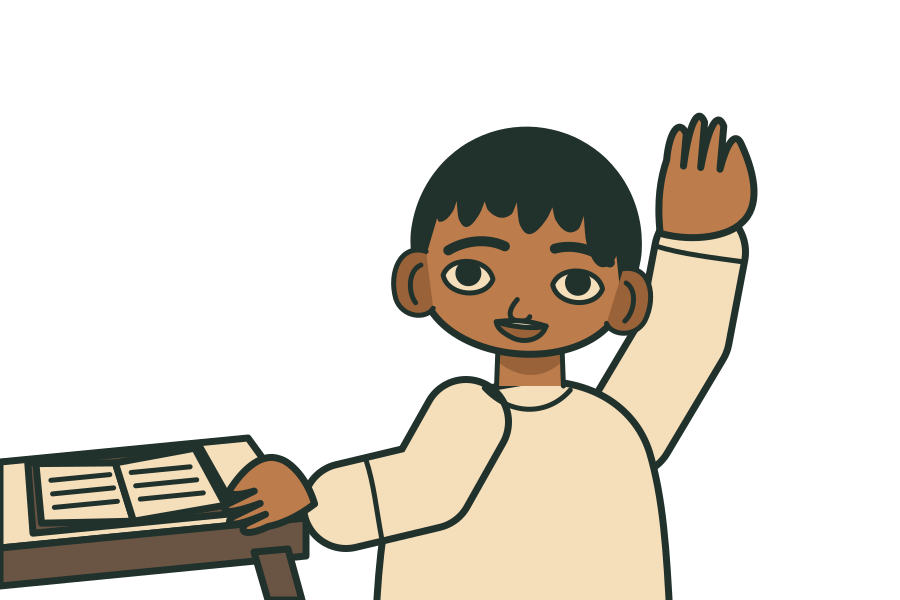
— the same boy, the same desk, at p. 101.
These new educating skills require
districts
able to share leadership
with educators.
Which is why the Lead Out Method abandons top-down control enforced with a priority of follow the schedule, in favor of involving educators in a new priority:
The Beautiful Problem:
How to get students nsidewhat they need to succeed?