
Inner educational exercises
Bottom line:
Only 15 – 30 minutes / day of Inner Educational Exercises.
Having said that:
It takes districts able to share leadership with educators;
allowing the very thing that gets students nside what they need to succeed.
Two types of inner exercises
There are two types — but they do overlap:
- Daily wellness exercises
- Skill-building exercises
Morning block — approximately 5 – 22 minutes
See the description of the Wellness exercises below:
- Morning affirmation
- Closing wellness exercise
- ESP exercise
Also below, some examples of Skill-building exercises:
- Wise part within exercise
- Will exercise
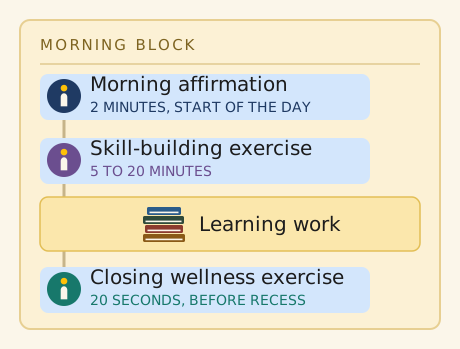

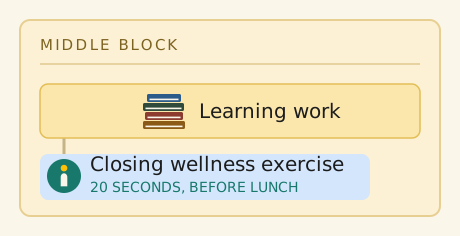
Middle block — 20 seconds
The same 20-second Closing wellness exercise used at the end of the Morning block.

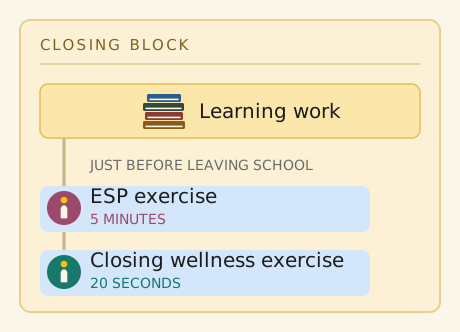
Closing block — 5 minutes, 20 seconds
The same 20-second Closing wellness exercise used at the end of the Morning and Middle blocks, preceded by a 5 minute ESP exercise described below.
Two categories of exercises
- Wellness (Morning affirmation, Closing and ESP)
- Skill-building (wise part within etc.)
1. Wellness
These wellness exercises are implementations of the new branch of psychology, Positive Psychology.
The idea is to build positive neural networks in the brain — new habits of well-being.
What is now well known is that wellness is not just the absence of illness, but the positive presence of various attributes, often referred to by an acronym, PERMA: Positive emotion, Engagement, Relationships, Meaning, and Accomplishment.
All of these exercises are designed to build PERMA in the brain.
The key is repetition — which is why they are a part of every school day.
Morning affirmation — about 2 minutes
This affirmation evokes the will. (Designed by Marva Collins.)
This day has been given to me, fresh and clean. I can either use it or throw it away…I promise it shall be used and not lost…
Closing wellness exercise — about 20 seconds
This exercise comes courtesy of Rick Hanson, Ph.D., a psychologist and Senior Fellow at UC Berkeley’s Greater Good Science Center.
Call to mind something just recently completed or started, and for 20 seconds feel good about it!
Students leave for each recess and at the end of the school day for home, feeling good that they applied themselves and made progress.
ESP exercise — about 5 minutes
Developed by Dr. Nate Zinsser, who for 31 years was Director of the Performance Psychology Program at the United States Military Academy at West Point.
The ESP exercise, as documented in his book The Confident Mind, is a journaling exercise.
Into a daily journal, at the end of the day, one writes down what one has put (E)ffort into, what one has (S)ucceeded at, and where one has made (P)rogress.
Here is Rick Hanson, Ph.D., giving a TEDx talk on why what we call Wellness exercises work so well.
2. Skill-building
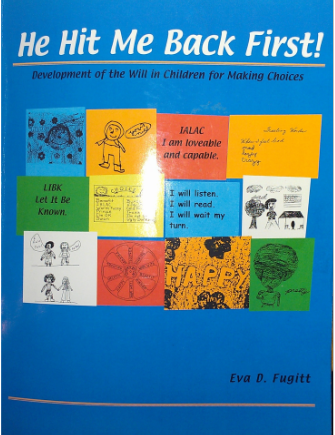
These examples come directly from Ms Fugitt’s book He Hit Me Back First!
— Eva D. Fugitt, He Hit Me Back First! Development of the Will in Children for Making Choices (Jalmar Press)
Wise part within exercise
Ms Fugitt recommends introducing the idea to the class, similar to this:
There is a wise part within all of us. There is a wise part within you. A wise part within me. A wise part deep within everyone you know. The wise part is so wise that it knows what is right for you far more than I. It is so wise it even knows what is right for me and what is right for the group.
One of the ways to get in touch with that wise part within is to sit quietly, take several deep breaths, so silently that you can hear the sounds in the next room. Breathe slowly, at your own rhythm. As you experience your body becoming quiet, you may wish to visualize in that creative place in your mind a lovely flower or a white fluffy cloud in a blue sky. You may visualize a diamond or a star above your head. Experience the silence. In that silence you may ask the wise part within for the help you need.
Will exercise
Again, directly from Ms Fugitt’s book:
Direct the children to perform a variety of seemingly useless tasks with their body by first saying the words, “I will…” before each task. Have the children repeat after you the “I will…” statement before performing.
- “I will tap the pencil ten times. 1, 2, 3…” (Count out loud.)
- “I will clap my hands five times. 1, 2, 3…”
- “I will stand on one foot for six counts. 1, 2, 3…”
- “I will pat my head with my left hand for 8 counts.”
- “I will…” (Teacher uses creative imagination.)
The ability to focus on one activity may be so lacking that a child will be able to tap the pencil only three times before he is distracted. Saying the words, “I will…” at the beginning of each statement is important to evoking the conscious use of will. These activities are comfortable and enjoyable to the children. Simple exercises such as these are as unlimited as the teacher’s creative imagination and act of will.
Other exercises
There are many more Skill-building exercises for developing whole human beings, including for example, Guided Imagery for strengthening attention span.
For adults
We highly recommend the work of Rick Hanson, Ph.D.
See his YouTube channel, and his online courses at rickhanson.com.